Senior Product Design Leader | Complex Platforms & Workflows
Case Study
Breezie | Head of UX & Design | 2016
Designing 'the internet made easy' - a two-part digital product for elderley and digitally disenfranchised users.

Key Results
-
Full product redesign launched in the US, 2016
-
Bronze award, Digital Services division, Aging 2.0 Awards, January 2016
-
Samsung pilot partnership announced, February 2016
-
Design team scaled from 1 to 5 across UX and visual design
-
Breezie was subsequently acquired by Vitaltech in 2018. The product foundation designed during my tenure continued to underpin the platform through that transition.
Project Overview
My Role
Head of UX & Design
My Team
Scaled from 1 to 4 - 2 visual designers and 2 UX designers
The Challenge
Breezie - a simplified internet experience for elderly and digitally disenfranchised users - needed a complete overhaul of both its core product (a Samsung tablet application) and its Hub (a remote access management tool for carers and family members). The existing product had been built without sufficient grounding in the specific physical, cognitive, and visual needs of it's target users. I was brought in to lead the research, define the redesign, and manage the team delivering it.
Tools & Methods
Axure · Adobe Creative Suite · User Stories · Continuous Discovery · Usability Testing


User Testing at Barchester Care Home
My Process
1. Defining the Problem
Before any design work began, I led a comprehensive definition phase to understand the specific challenges elderly users face when navigating digital products - including diminished contrast perception, reduced targeting precision due to hand tremor, and slower cognitive processing.
What I did
-
Led competitor analysis and heuristic evaluation of the existing product
-
Conducted user testing and interviews at care homes and community groups
-
Researched the specific physical and cognitive challenges of elderly users
-
Reviewed quantitative analytics to identify friction points and drop-off
Outcome: A shared understanding of customer goals and required functionality that aligned Product, Engineering and leadership around common objectives for the first time - and a clear brief for what needed to be built.
2. Planning and Scope Definition
Working with the client, I translated research findings into personas and user stories, then prioritised the workload and defined a realistic delivery roadmap within a constrained timeframe.
A key insight shaped the entire design approach:
"Elderly users have a tendency to be more easily disorientated. Strong sign-posting and clear orientation are more important than a reduced click-through."
3. UX Design
I defined the new taxonomy and core information architecture for the device, working initially with stakeholders on whiteboard sketches before translating these into site maps and high-fidelity wireframes. Interface designs were marked up with full build and interaction specifications for the development team.
Design constraints were significant and specific - layouts had to account for diminished targeting skills, hand tremor, and slower cognitive processing. I maintained ongoing user testing relationships with care homes and community groups throughout, iterating continuously on the designs in response to findings.


Sketching Wireframes and sitemapping by me


Annotated Interface and Interaction Design Document for the Breezie App, by me
3. Visual Design
I directed the visual redesign of the product, applying principles specifically derived from our research into elderly users' needs: high contrast ratios to compensate for diminished colour perception, high x-height sans-serif typography for legibility, and a warm, welcoming visual language to reduce anxiety and build confidence with a user group for whom digital products can feel intimidating.


Screens from the Visual Design Guidelines Document produced by the visual Design Team
3. Build and Delivery
Design and development worked side by side in an agile methodology. Annotated wireframe documents were complemented with interactive prototypes for more complex interactions. I managed the UX and visual design teams delivering both the Hub and the Device in parallel, maintaining quality and pace through to launch.


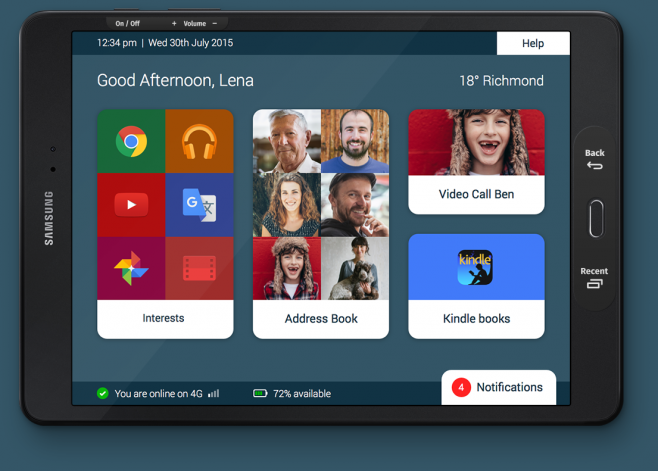


Screengrabs of the final Breezie App

Outcome
The redesigned Breezie launched in the US in November 2015. Within months the product had won a Bronze Aging 2.0 Award for Digital Services and secured a Samsung pilot partnership - strong external validation of the design quality and market fit of the redesigned product. Breezie has continued to grow in the US care home market.